
Second Version of the IPCEI-CIS Reference Architecture Released
With the release of Version 2.0 of the IPCEI-CIS Reference Architecture (ICRA), the 8ra Initiative continues to support building a sovereign, interoperable digital infrastructure for Europe. The ICRA offers a structured framework to guide the development of a federated Multi-Provider Cloud-Edge Continuum capable of supporting the next generation of data-driven applications across sectors such as manufacturing, mobility, energy as well as the integration of AI.
Introduction to Version 2.0
The Reference Architecture supports the goal of compatibility, interoperability, and portability among the different IPCEI-CIS implementations. Version 2.0 enhances the detail on sustainability and security, and introduces new sections on Federation and Interfaces.
Functional components are described and organised into layers to clarify the systems needed to support the European Multi-Provider Cloud-Edge Continuum.
As a strategic instrument within the 8ra Initiative, the architecture serves both a technical and unifying function. It enables more than 120 partners across 12 EU member states to position their technologies and roles within a shared reference model, providing the structural clarity required to advance Europe’s goals of technological independence and cross-border digital integration.
A modular framework for interoperability
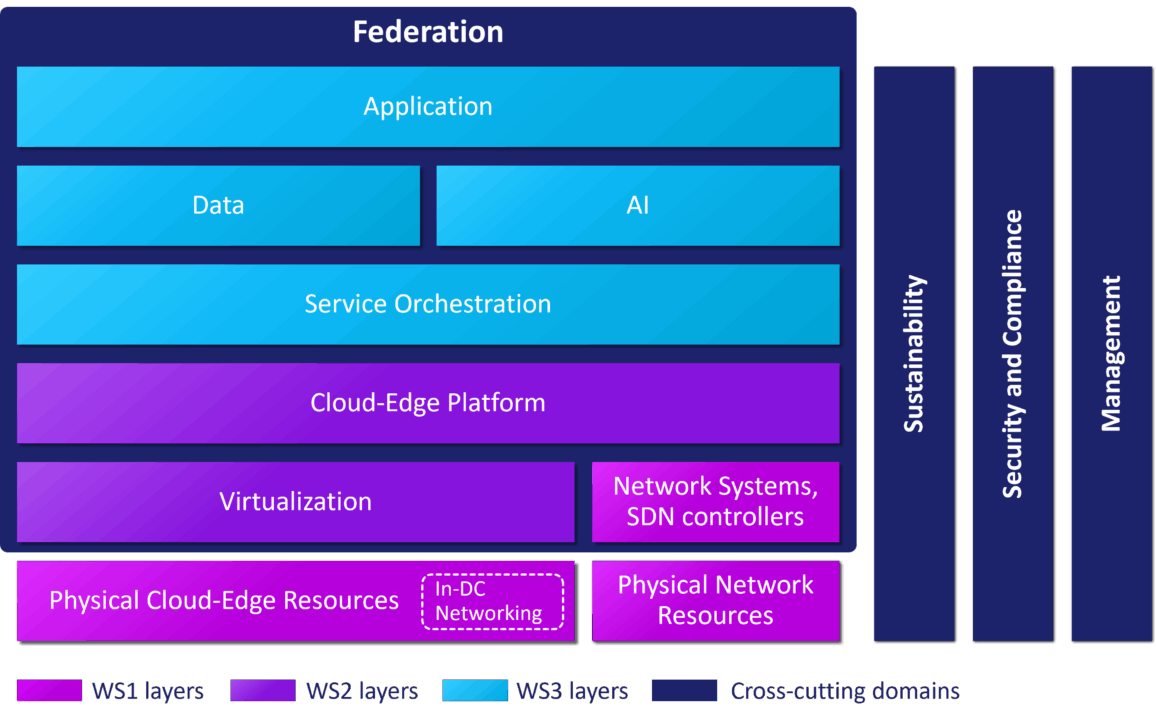
The architecture is built as a layered, modular model encompassing the entire cloud-edge stack. It spans from physical and virtual infrastructure to orchestration, platform services, data handling, and artificial intelligence, each layer designed for interoperability in distributed, multi-provider environments.
This integrated approach reflects 8ra’s ambition: not only to establish a technological foundation, but to ensure it is resilient, trustworthy and future-ready.
Overview of the architecture
Core architectural layers:
- Application Layer: End-user applications and function catalogues.
- Data Layer: Trusted, distributed data exchange across the continuum.
- AI Layer: Fundamental set of advanced functionalities.
- Service Orchestration Layer: Unified, automated coordination of services.
- Cloud-Edge Platform Layer: Lifecycle management and service deployment.
- Virtualisation Layer: Abstraction of compute, storage and networking resources.
- Network Systems Layer: Management of virtual and physical network components.
- Physical Layer: Underlying hardware and connectivity infrastructure.
Cross-cutting domains:
- Federation: Mechanisms to enable seamless provider collaboration, including dynamic service handovers and alignment with the EU Data Act.
- Management: Integrated capabilities for monitoring, SLA compliance, automation and resource accounting.
- Security and Compliance: Safeguarding data integrity, access control and compliance with industry standards and regulations.
- Sustainability: Optimisation for energy efficiency and renewable resource integration.
New Chapters in Version 2.0
Federation
The new chapter outlines the role of federation in cloud-edge infrastructures.
A closer look at Federation Principles in the context of a Multi-Provider Cloud-Edge Continuum is included. In addition, the core components Federation Manager and Federation Broker are described. The benefits of flexible integration are shown, for example the collaboration of multiple providers while maintaining independent environments.
Functional Interfaces
The new section “functional interfaces”, focusses on the essential interfaces for all the possible Architecture implementations in a high-level abstraction. This is a step towards the identification of essential interfaces contributing to an independent European Cloud-Edge Architecture. Based on a comprehensive analysis, 9 key interfaces are described, ranging from various stack layers to broader aspects like federation, management, sustainability and security. For each of the interfaces, the key technologies on which they are based are shown, including links to the respective communities, standardisation bodies and industry forums. In addition, project usage is outlined and a look on state-of-the-art implementations included.
Outlook
The next version will offer more detailed descriptions of mechanisms and solutions for integration, exposure and federation, capturing the experience gained with the pilots and advancements within the individual Research & Development projects under the IPCEI-CIS.
Future incremental versions will include additional details and use cases. A comprehensive definition of domain components within each layer and their interconnections will also be addressed.
Explore & Contribute
Version 2.0 of the IPCEI-CIS Reference Architecture is now publicly available. Stakeholders are encouraged to explore the full document and to engage with the interactive version on the CISERO platform, where comments and suggestions can be submitted to support the development of future releases.