
PoQuaSIA Demonstrates Secure Cloud-Edge Connectivity for Next-Generation Mobility
On 1 December 2025, the (StVFernLV) will enter into force in Germany, establishing for the first time a legal framework for the operation of teleoperated vehicles on public roads. The regulation marks a milestone for the mobility sector, enabling the safe testing and deployment of vehicles that are remotely controlled from a dedicated control station.
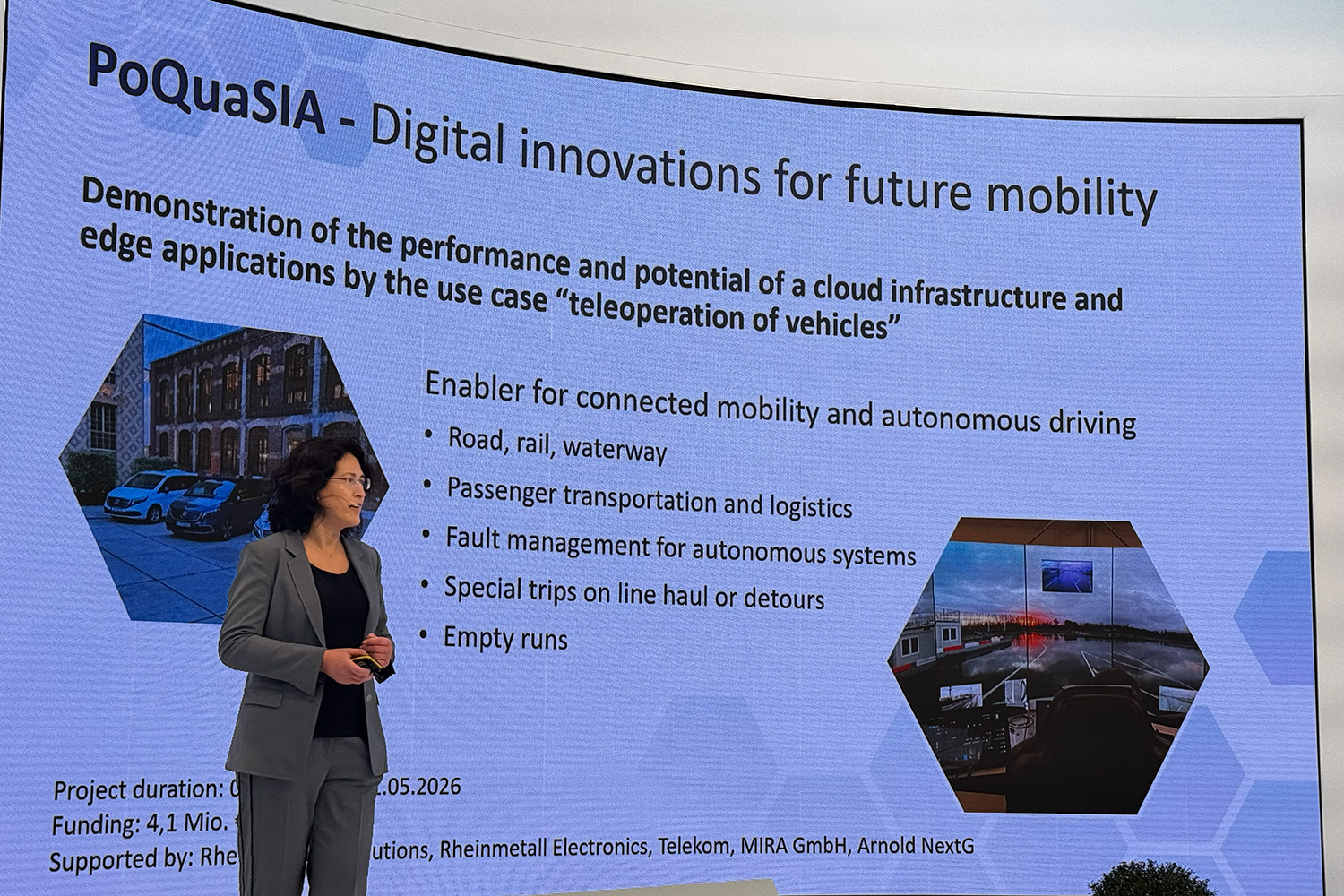
Within this context, the PoQuaSIA project – Development of a distributed and scalable IoT platform using a post-quantum secure cloud data connection – demonstrates how secure, low-latency communication between vehicle systems and cloud environments can make such teleoperated mobility a reality. Led by Rheinmetall Technology Center GmbH, and supported by MIRA GmbH, Rheinmetall IT Solutions GmbH and Rheinmetall Electronics GmbH , the project develops a post-quantum secure IoT platform that connects decentralised edge-nodes and central cloud infrastructures.
Secure infrastructure for reliable teleoperation
Teleoperation – or the remote control of a vehicle from a control station – places particularly high demands on security, latency and availability. To meet these, PoQuaSIA integrates real-time fleet and route management, post-quantum encryption mechanisms, and a resilient computing infrastructure designed for safety critical applications. These components are tested in real environment and optimized for secure operation, supporting the transition of teleoperation from research to regulated deployment.
With the new regulation, Germany recognises teleoperation as an independent mode of vehicle operation, creating the legal certainty needed for industrial implementation. This step provides a strong signal for innovation and positions Germany as a frontrunner in shaping the future of connected and automated mobility. Insights from PoQuaSIA’s testing phase, covering over 3,000 kilometres in pilot operation, contribute to refining technical standards and legal frameworks in cooperation with certification bodies and authorities such as TÜV, Kraftfahrt-Bundesamt and the German Federal Ministry of Transport.
Strengthening Europe’s cloud-edge ecosystem
Teleoperation can complement autonomous driving by enabling human intervention in complex situations, improving operational safety and efficiency. Applications range from public transport and logistics to agriculture and industrial operations, including remote deployment in hazardous environments.
The PoQuaSIA project exemplifies how secure, scalable and interoperable cloud-edge infrastructures – a key goal of the 8ra Initiative and the Multi-Provider Cloud-Edge Continuum – can enable new mobility models and strengthen European digital sovereignty. By combining post-quantum security with decentralised computing, PoQuaSIA supports the development of resilient, future-proof digital infrastructures across Europe.