
Europe’s next AI chapter will not be written only in hyperscale data centres. It will unfold in hospitals, industrial facilities, and other environments where data is sensitive, regulated, and often unable to move. That reality poses a structural question for Europe: how can AI scale when data cannot be centralised?
Voices of 8ra
This interview series highlights the leaders shaping the Multi-Provider Cloud-Edge Continuum across Europe. We explore the strategies and challenges driving innovation within the 8ra Initiative – set against the backdrop of shifting political priorities, rapid technological change, and evolving societal and economic needs that are redefining Europe’s digital future.
April 2026
In Conversation with Antal Kuthy and Ákos Tényi, E-Group
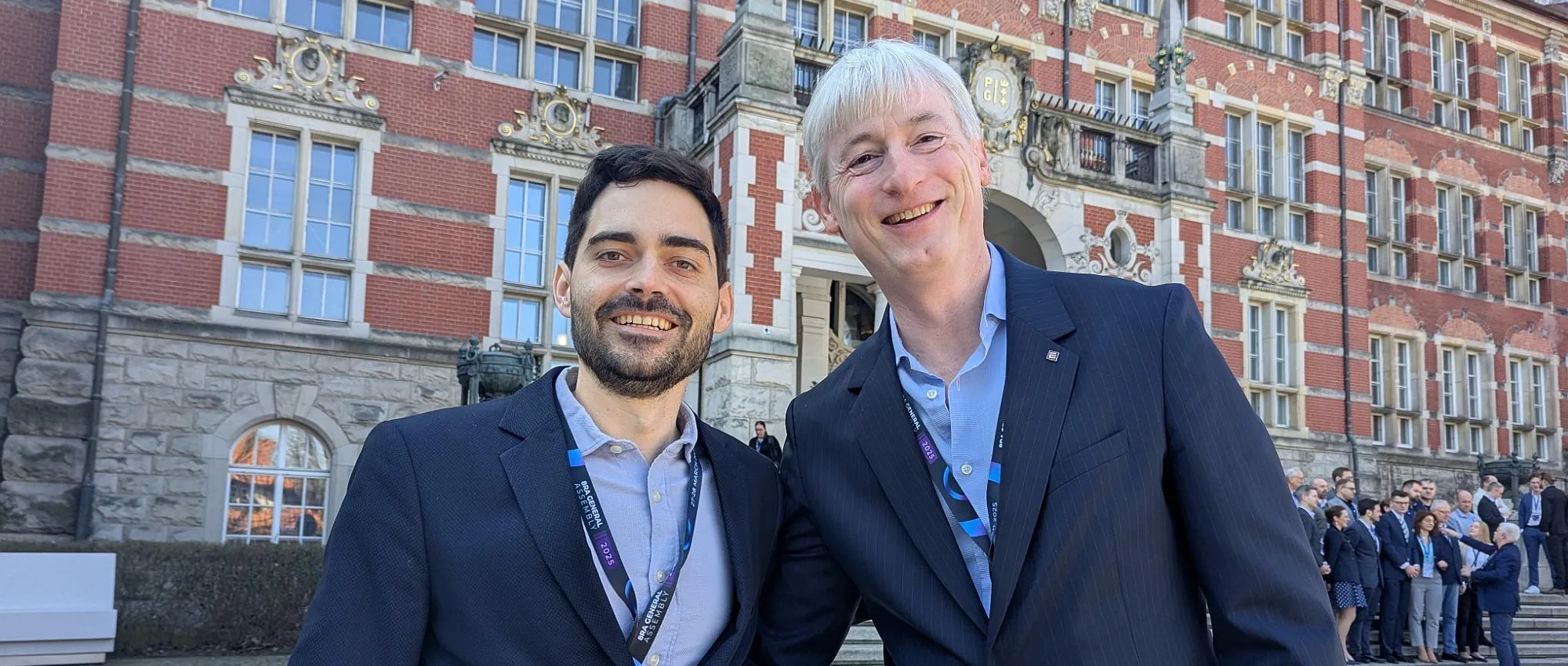
In this conversation, Antal Kuthy, Founder & CEO of E-Group, and Ákos Tényi, who leads E-Group’s Federated AI (FedX) product line, describe how their Hungarian IPCEI-CIS project FedEU.ai approaches that challenge through federated learning and distributed compute. Instead of moving data, their systems move models and intelligence to where data already lives.
Their work reflects a core ambition of the 8ra Initiative: turning Europe’s distributed landscape – across countries, providers, and infrastructures – into a practical advantage. Within the Multi-Provider Cloud-Edge Continuum, E-Group is testing what it takes to make AI deployable across borders, providers and compliance regimes, without forcing organisations to give up control of their data.
To start: who are you, and what is E-Group’s role in 8ra and IPCEI-CIS?

Antal Kuthy: “I’m the Founder and CEO of E-Group, and I still consider myself an engineer. We’re a human-centric, sovereign AI-focused technology group based in Budapest, active since 1993. Within the IPCEI-CIS we are a direct partner and we lead Workstream 3, which focuses on developing advanced cloud and edge services that enable seamless support deployment across the Multi-Provider Cloud-Edge Continuum. Our 8ra project FedEU.ai is about federated AI, specifically federated learning on distributed data and distributed compute.”
Ákos Tényi: “I lead our Federated AI (FedX) product line, our platform work. The core technology is federated learning, but alsoeverything around it: training, inference and making it usable in real-world deployments. I also run E-Group’s IPCEI-CIS programme as delivery manager, so I’m heavily involved in the Workstream 3 collaboration and in connecting what partners build into tangible outcomes.”

Your project is called FedEU.ai and described as “Connecting AI Knowledge”. What does that mean in practice?
Antal Kuthy: “We start from a real-world condition: data is distributed and compute is distributed. So, the question is: what kind of AI continuum works under those conditions? FedEU.ai is built around federated learning on distributed data and distributed compute -and what that implies for future architectures, including agent-based AI systems.”
Ákos Tényi: “A key idea is decoupling. In our vision, private data, AI processing services, and insight generation can be fully separated from each other. That allows privacy-preserving data spaces to be deployed flexibly, for cloud, edge or on-premises. And you can go further: algorithms can access data, and models can train, using privacy-preserving techniques.”
Which users and use cases are you targeting and why is the Multi-Provider Cloud-Edge Continuum essential for them?
Antal Kuthy: “Healthcare is a clear example. Clinical data, genomics and biobanks cannot simply be pooled in one place, especially across borders. The challenge becomes how to build federated data networks and use distributed compute to generate higher-value insights.
Beyond healthcare, we see similar constraints in industrial edge environments, autonomous systems, robotics, and even space-related infrastructures. In all of these, moving large volumes of data is often unrealistic. Edge intelligence and federated governance become essential.”
Ákos Tényi: “In Workstream 3 we agreed early on that ‘edge’ is often defined through the telco view, which means low latency. While this is an important benefit of edge computing, many of our deployments are driven by other factors: data privacy, IP protection and control. In those cases, you don’t want to move data to another partner or a central cloud. You move compute to the edge instead. The Multi-Provider Cloud-Edge Continuum is what makes that possible across different providers while still allowing collaboration.”
How does the multi-provider aspect help companies operate across borders with confidence?
Ákos Tényi: “We are running several projects with data providers from different countries, and cross-border handling is still very national in Europe. The multi-cloud aspect helps because it enables services where clients find it acceptable to operate – and it gives users a choice of provider and environment. Some organisations won’t choose a single default; they want options that fit their compliance needs, their risk view, and their partners. The continuum makes that choice practical.”
You lead Workstream 3 and you started the project Ambiti8n. What is the aim and what makes it special within 8ra?
Antal Kuthy: “Ambiti8n is about building a doer culture. Integration requires momentum and a willingness to leave the comfort zone. In complex, cross-border technology programmes, everyone has good methodologies. And we are still human, and humans need energy. Ambiti8n brings that spirit into technology development.
Technically, we’re also making a point: Workstream 3 should not deliver concepts or isolated artefacts. It should deliver software services that can live inside the Multi-Provider Cloud-Edge Continuum. That changes how you measure progress. People talk about TRL – technology readiness level – and that’s valuable. For services in a continuum, we also need what we call Component Readiness Level: not only ‘is it built?’, but ‘can it live in the ecosystem?’ What attributes does it need? How can it be orchestrated across partners?
This will become important when we move beyond the current approach of building architectures with system architects to define interfaces and components. In the future, orchestration should become more automated, assisted by agents and 8ra’s intelligence. Ambiti8n helps by identifying the attributes of components so they can be activated horizontally as well as across workstreams. Ambiti8on is a horizontal (WS3) component activation pilot that works closely with, and relies on, other pilots, testbeds that can provide vertical federation functionalities to enable Ambiti8n components to operate within the 8ra continuum.”
From your perspective as a service provider: How does Ambiti8n support smooth deployment of services across Europe?
Ákos Tényi: “The goal is simple: deploy once, run across Europe. Service providers need standardised interfaces they can deploy against. Without that convergence, deploying the same service in different national edge environments becomes repetitive, expensive and slow.
With the collective effort of Ambiti8n, we demonstrate many of the features, especially federation, of the IPCEI-CIS reference architecture that make this goal possible. We can surface possible issues early and feed concrete requirements back into the architecture discussions.”
Antal Kuthy: “And from the 8ra perspective, this is where the continuum becomes a living ecosystem: components are not just built; they are combined. That activation creates pull for component maturity across the architecture and creates momentum across workstreams.”
What business opportunities do you see emerging from 8ra?
Antal Kuthy: “8ra provides a safe environment to test how federated AI components can be deployed and combined. It also helps companies adapt their product strategies for a future where compute, energy and information are increasingly distributed. Brute force is not the only way to move forward. Innovation is another way to move forward, too. Energy generation is distributed, and compute increasingly follows similar patterns. Instead of building ever-larger central resources, we should ask how to use what already exists more intelligently and reinvest savings into innovation. I also believe Europe needs a hybrid strategy, meaning running a complex regulatory and procurement/technology acceptance strategy that, at every decision point, considers by design how resilience and independence can be achieved, always securing multiple alternatives for those areas where we are not yet strong enough. The European technology sector must be defined by what it stands for, not by what it stands against. The usefulness of others should be carefully but rigorously weighed and applied where appropriate, and industrial policy must listen to those who are actually doers and who, in that sense, are on the frontline of reality. Reality matters.
For this to work, business has to be part of the equation. Technology alone is not enough. 8ra should not end with projects delivered according to technical plans. The real opportunity lies in creating momentum across the community, so that 1+1=3 by enabling companies to create business opportunities for each other.
As an SME, we can build strong components, but adoption only happens when those components find their way into real use cases. At the end of the day, incentives matter. If there is no business case, even very good technology will not be adopted.”
Ákos Tényi: “For many companies, including SMEs, this is also a cloud-adoption journey. It changes how services are built, delivered and scaled across multi-cloud and cloud-edge environments. Over time, it becomes part of the DNA of the company.”
Antal Kuthy: “To get there, we cannot lose patience. At the end, we are talking about tedious integration and delivery work. We have to be willing to get our hands dirty. A lot of value has emerged from 8ra, especially over the past twelve months, but we still have long way to go and should not overpromise, neither under perform. Ultimately, collaboration only creates impact if it leads to real adoption.”
Kuthy’s and Tényi’s perspective points to a core challenge for Europe’s digital future: sovereignty will not be achieved through scale alone. It depends on whether AI systems can operate across borders, providers and regulatory regimes without forcing data into central silos.
With FedEU.ai, E-Group is testing how federated AI can turn Europe’s distributed reality into a practical advantage, by moving models to data, not data to models. Through Ambiti8n, the company is also pushing a broader shift within 8ra: components should not only be built, but be ready to integrate, combine and run across a multi-provider environment.
The underlying message is deliberately pragmatic. Europe may not win the AI race through brute force. But it can compete by making innovation deployable, so that collaboration creates real economic value and sovereignty becomes something organisations can implement, not just debate.
About Antal Kuthy and Ákos Tényi
Antal Kuthy is Founder & CEO of E-Group ICT Software Zrt. (Hungary). Ákos Tényi leads E-Group’s Federated AI (FedX) product line and coordinates its IPCEI programme delivery activities. Within the 8ra Initiative and IPCEI-CIS, E-Group contributes through Workstream 3 and develops FedEU.ai, a federated cloud-edge AI continuum based on privacy-preserving and federated computing elements. The project focuses on decoupling data from processing and insight generation across cloud, edge and on-premises deployments, enabling trustworthy, scalable AI services while keeping data assets protected. Learn more on the project page.