
Dr Gunnar Schomaker on how joint collaboration became 8ra’s biggest achievement
Voices of 8ra
This interview series highlights the leaders shaping the Multi-Provider Cloud-Edge Continuum across Europe. We explore the strategies and challenges driving innovation within the 8ra Initiative – set against the backdrop of shifting political priorities, rapid technological change, and evolving societal and economic needs that are redefining Europe’s digital future.
August 2026
In Conversation with Dr Gunnar Schomaker,
Scientific Consultant of SDEC and co-lead of the cross-cutting workstream on sustainability, University Paderborn
To start things off: Can you briefly introduce yourself and tell us your role in the project and 8ra Initiative?
“I work at the Software Innovation Campus at Paderborn University, focusing on advanced computing and sustainable digital infrastructures. For many years, my work has centred on how to bring computing infrastructure and renewable energy systems much closer together. This led me to invent the WindCORES concept, placing data centres directly inside wind turbines, which we now realise in the 8ra project SDEC. Beyond that, I share responsibilities for the cross-cutting workstream on sustainability to ensure that sustainability is not treated as an isolated feature within individual projects, but integrated as a fundamental design principle across the entire European cloud-edge ecosystem.”
As co-lead of the sustainability workstream, what are your primary focus areas, and how does 8ra’s model challenge traditional approaches to cloud sustainability?
“Our goal is to make sustainability an operational property of the Cloud-Edge Continuum. To achieve this, we need a system-wide perspective, integrating energy efficiency directly into the infrastructure, alongside heat reuse, and energy-aware computing, so workloads are dynamically scheduled where it makes the most environmental sense.
This combination of distribution and federation is what truly sets 8ra apart from traditional approaches. Federation allows diverse, local resources to work together seamlessly while providers retain full control over their infrastructure.
Sustainability and resilience are deeply connected here. Physical distribution across different locations and energy sources naturally mitigates concentrated risks. While traditional data centres spend massive resources on local redundancy because each site is built to survive on its own, a federated, distributed system can be designed to become inherently self-healing.”
How far along are we with this mission? Are these concepts already in place, or where do we currently stand?
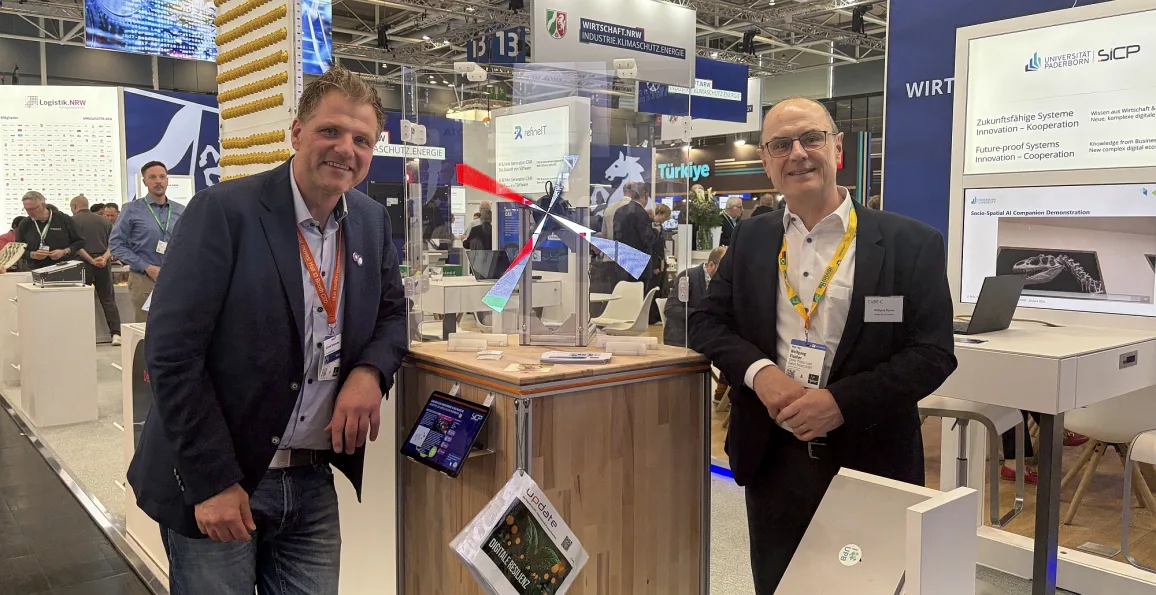
“I wouldn’t put a precise percentage on where we stand, but I am genuinely convinced by what we’ve achieved so far. When you look at our joint events and showcases at events such as Hannover Messe, you can see how much progress the individual projects have made. You can actually see workloads being shifted, interdependencies balanced, and compute power routed to where renewable energy is available or waste heat can be utilised.”
“Most importantly: the mindset is federated now.”
Dr Gunnar Schomaker
Which specific sustainability Use Cases are you particularly excited about? Could you give us a concrete example on how this will look in practice?
“I’m always excited when we do something completely opposite to everyone else. If people say ‘Nobody seems to be doing that’, the first thing that comes to my mind is ‘Why?’. Our WindCORES concept is a great example. We build data centre rooms directly inside the base of wind turbines. When you step inside, it looks and sounds like a normal enterprise data centre. We need modular, multi-site infrastructure. Our setup provides the perfect living lab to test high-density compute directly at the energy source, proving that a sovereign, distributed approach actually works.
When we patented it, people called us asking ‘for a friend’ if they could use the concept. Our answer was: ‘Please, just do it!’ The only way to get rid of the ridiculous reliance on centralised mega-sites is to build a community that brings computing directly to the energy production site.”
The European Commission recently published its European Technological Sovereignty Package, which includes a strategic roadmap on digitalisation and AI in the energy sector. Have you had a chance to look at it, and how does it align with your work?
“I share the main principles addressed in the roadmap. They cover very closely what we are following in 8ra, with central topics like sustainability, renewable integration, waste heat reuse, and energy-aware computing.
We are at a point where we need breakthrough innovation, not only incremental innovation. We should look at next-generation technologies like photonics, which have the potential to reduce energy consumption dramatically.
We have the potential to define European attributes that we can deliver as strengths and bring them into our cloud ecosystem. In the future, a sovereign digital sector could become for Europe what the automotive industry was in the past: the foundational backbone of our entire economy.”
When we talk about cross-workstream efforts, you have to bring different technologies and partners together. What are the main challenges you’re facing in this context, and how is 8ra overcoming them?
“When so many partners come together in an initiative of this scale, different emotions and dynamics happen. Everyone brings great ideas, but there is sometimes the fear of being overlooked. We had to navigate this evolving landscape together.
What really helped overcome this was seeing the effort that was put into bringing people together, creating transparency, and really forming a shared understanding for the European mission that had to be translated into the individual projects. Once that alignment happens, it feels like surfing a wave and you can use this collective force to accelerate.
On a personal level, my key moment was when I was discussing immersion cooling with a partner and we realised that we were facing exactly the same technical challenges, and suddenly an alliance forms. That personal connection and shared mindset is how 8ra turns physical distribution into actual collaboration.”
Looking five years into the future: What is the one milestone or impact where you would say 8ra was truly successful?
“If, in five years, we have a truly vendor-independent ecosystem where customers are no longer dropped into a tank full of sharks, but guided to the best solution for their specific needs, then I would say we were successful.
Right now, market decisions are heavily dominated by traditional hyperscalers because companies choose to go for the safe choice and stick to what everyone else is doing. I want to get back to the original vision of the cloud: a dynamic ecosystem where you orchestrate your requirements, select the best fit, and if your demands change, you can reconfigure your service chain without migration costs eating up all the benefits. Success for 8ra means that fairness, sustainability, and technical match win over huge marketing budgets.
At the same time, looking back at how fast technology evolves: if history has taught us anything, it’s that the reality in five years will far exceed what we can imagine today.
So the most important attribute we have to implement in 8ra is the ability to embrace change. We need to be agile and flexible enough to adapt to change. If we establish that mindset, Europe’s digital future will be in a very good place.”
About Dr Gunnar Schomaker
Schomaker is Head of Research for Advanced Computing and Sustainable Digital infrastructure at the Software Innovation Campus Paderborn, Paderborn University, and inventor of the WindCORES concept. Within 8ra, he acts as scientific consultant for the SDEC project and co-leads the cross-cutting workstream on sustainability.
Driven by WestfalenWIND IT, the SDEC project researches and builds edge data centra infrastructures located directly inside wind turbines. By estabilishing a cooperative co-location operating model, SDEC merges data centre architecture directly with renewable energy generation.