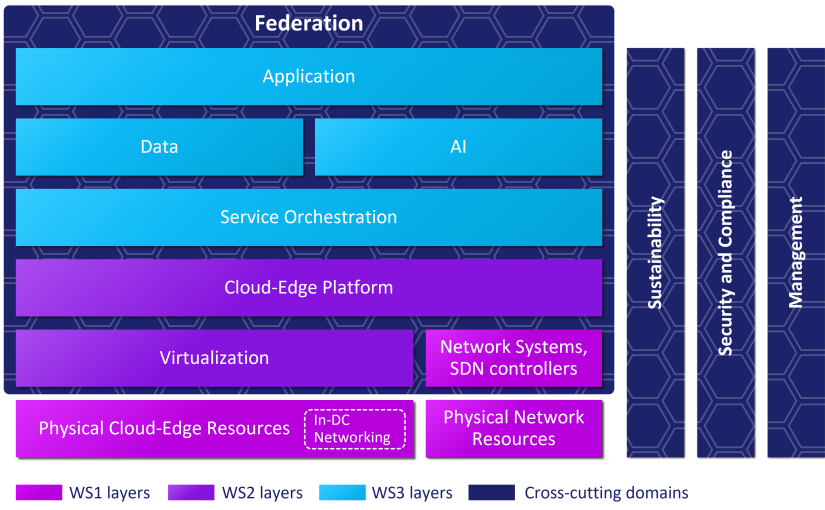
Version 3.0 of the IPCEI-CIS Reference Architecture (ICRA) is now live, a structured framework to guide the development of a federated Multi-Provider Cloud-Edge Continuum, capable of supporting the next generation of data-driven applications across sectors such as manufacturing, mobility, energy as well as the integration of AI.
Introduction to Version 3.0
By enabling seamless interoperability across diverse IPCEI-CIS implementations, the Reference Architecture guides the execution of pilot and integration scenarios. Its functional components are structured into clear layers, outlining the systems needed to power the European Multi-Provider Cloud-Edge Continuum.
Version 3.0 provides greater context on how the Reference Architecture relates to the overall IPCEI-CIS mission, alongside expanded sections on federation, sustainability, and AI.
As a strategic instrument within the 8ra Initiative, the architecture serves both a technical and unifying purpose. It enables more than 120 partners across 12 EU member states to position their technologies and roles within a shared reference model, providing the structural clarity required to advance 8ra’s goals of technological federation and cross-border digital integration.
A modular framework for interoperability
The architecture is built as a layered, modular model encompassing the entire cloud-edge stack. It spans from physical and virtual infrastructure to orchestration, platform services, data handling, and artificial intelligence, each layer designed for interoperability in distributed, multi-provider environments.
This integrated approach reflects 8ra’s ambition: not only to establish a technological foundation, but to ensure it is resilient, trustworthy and future-ready.
Overview of the architecture
Core architectural layers:
- Application Layer: End-user applications and function catalogues.
- Data Layer: Trusted, distributed data exchange across the continuum.
- AI Layer: Fundamental set of advanced functionalities.
- Service Orchestration Layer: Unified, automated coordination of services.
- Cloud-Edge Platform Layer: Lifecycle management and service deployment.
- Virtualisation Layer: Abstraction of compute, storage and networking resources.
- Network Systems Layer: Management of virtual and physical network components.
- Physical Layer: Underlying hardware and connectivity infrastructure.
Cross-cutting domains:
Sustainability: Optimisation for energy efficiency and renewable resource integration.
Federation: Mechanisms to enable seamless provider collaboration, including dynamic service handovers and alignment with the EU Data Act.
Management: Integrated capabilities for monitoring, SLA compliance, automation and resource accounting.
Security and Compliance: Safeguarding data integrity, access control and compliance with industry standards and regulations.